
What is ATR?
What is ATR?
Principle of Optical Waveguide Spectroscopy
Optical Waveguide Spectroscopy is an epoch-making UV/Vis absorption spectrum measurement method that enables selective measurement of surfaces and interfaces of the sample, high-sensitivity real-time measurement, and collaboration with other measurement methods. The principle is shown in Fig1.

Fig.1 Optical arrangement of Optical Waveguide method
This is a measurement method that uses evanescent waves generated on the opposite side of the total reflection interface. The characteristics of the evanescent waves are shown in Fig.2
As you can see, the electric field strength of the evanescent waves is strongest at the interface, and it weakens exponentially as it moves away from the interface.
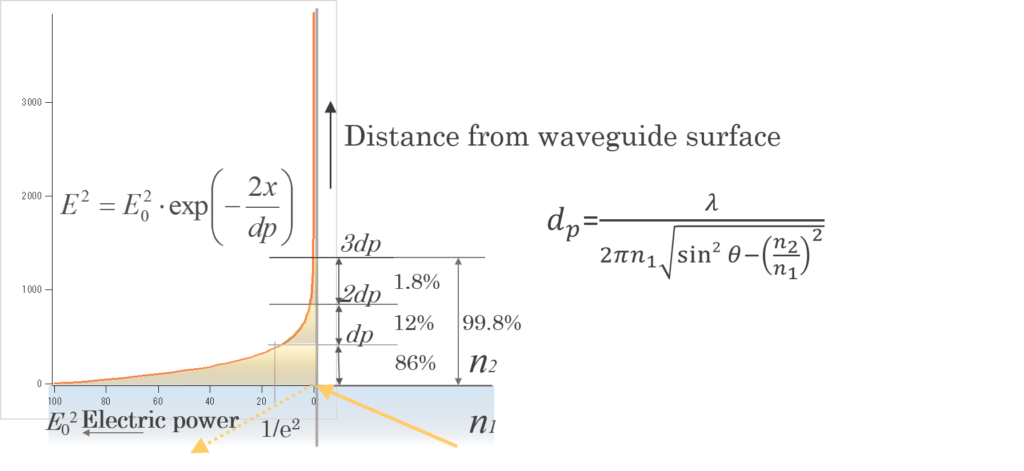
Fig.2 Intensity of Evanescent waves
Since the evanescent wave reflects not only characteristics of the wavelength but also the characteristics such as wavefront and phase, it is possible to obtain information on the orientation of molecules. Above all else, it is a very convenient tool that can obtain real-time information on reactions and molecular responses.
The SIS-5100 is the platform for various applications such as Surface Plasmon Resonance (SPR) measurement of non-absorption samples, fluorescence (spectral) measurement, and simultaneous measurement with electrochemical measurement as well as absorption measurement of waveguide. (Fig.3)

Fig3. Optical Waveguide Spectroscopic Measurement Platform
The research areas where we can make the best use of our SIS-5100 are reactions and responses on surface and interface of the sample, and changes of the sample over time. And this system is very useful to observe the dynamics of molecules at the monolayer level. In molecular devices and organic devices, it is also used to observe differences in molecular assembly and changes in molecules and aggregates due to external stimuli such as various chromism changes.
In the field of biology, it is used for basic research on biosensors and analysis of biomolecules. In some cases, cells and microorganisms are measured alive.
For inorganic, bandgap of TiO2 nanostructure can be measured. In a special case, it is used to measure the absorption spectrum without diluting a high-concentration dye that cannot obtain absorbance by transmission.
It can measure not only liquids but also solids (organic crystals, film surfaces, etc.), adsorbed molecules from gas and gas phase with high sensitivity.